Sacred Space at Home
By Anne Knorr

Sample Chapter Excerpt
Archetypal Patterns of Sacred Space
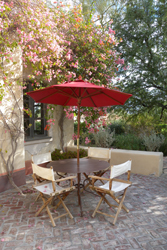
"Fill your life and your world with the colors, textures, scents, and objects that are beautiful to you, that have meaning to you. Remember that we are connected to our environment. The objects and the colors in our world have energy and meaning. They have an impact on us."
~Melody Beattie
Journey to the Heart
________________________________________________________
Archetypes
Archetypes are patterns that have existed throughout time. They resonate with our core being or essence,helping us articulate what makes a place feel sacred. Archetypes come in many forms: common personality types, repeated shapes and forms of structures, rhythms of the seasons, the cycles of the sun and the moon, the cadence of an ocean wave and even the steady beating of our heart. Physical archetypes—such as the dome, the cube, and the pyramid—have appeared in many cultures around the world and have been used repeatedly throughout history. Archetypes are patterns that speak a language deeper than words—just as symbols, poetry, and great art do—and they feel familiar. They’re a link between our ancestors and us, and also a link between human beings and the eternal qualities of God. If we listen, archetypes will help us be in rhythm with the design of the universe, and when we are aligned with this ancient wisdom we encounter sacred space in the places we dwell, both in spirit and form.
Ancient Sacred Structures
One of the foundational archetypes in sacred buildings is a numeric pattern of three, a number associated with the Divine, the Great Spirit, God, or the Source of Life. The Tabernacle, an ancient Jewish tent used for worship, is an example of a structure that embodies this pattern by including three major spaces: the Court, the Holy Place, and the Holy of Holies. Similarly, Buddhist temples consist of three essential buildings: the pagoda, the great hall, and the monastic study hall. The Great Pyramids of Egypt are grouped in threes. If we understand how this simple pattern of three works, we can integrate it into our homes and our lives to create beautiful spaces that are balanced and spiritually alive. The archetype, as expressed in the Jewish Tabernacle, provides the template we need.
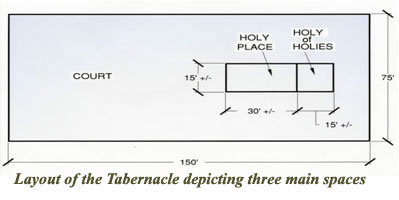
The Tabernacle was divided into three spaces that included a large, open-aired, public area known as the Court, a quiet, enclosed private space called the Holy Place, and an intimate room in complete darkness and silence that was the Holy of Holies. Each space expressed different aspects of the sacred experience and enhanced one another. Rituals tied the three spaces together as the progression of movement flowed toward the stillness of the Holy of Holies and back out to the boisterous court. Like the inhalation and exhalation of breath, this movement back and forth between the three spaces kept the Tabernacle alive—a living, breathing sanctuary—breathing in toward silence, exhaling out into community.
Pattern of Three
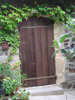
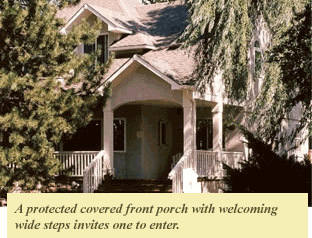
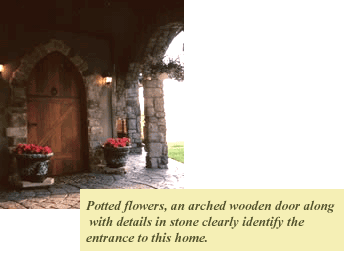
If we look at the pattern of Three Distinct Spaces Comprising the Whole, we can begin to evaluate our own homes and try to incorporate this pattern into our living spaces. The first step is to identify the spaces in our home we consider similar in character to the Outer Court, the Holy Place and the Holy of Holies, or simply the public, private and intimates places. The Outer Court was a large enclosed outdoor area where families, animals and priests gathered in preparation for making an offering to God. Entrances, front porches and front yards where we welcome people into our presence are a few examples of public areas in our home. A home in Hawaii has a beautiful wooden door that opens into a courtyard similar to the Outer Court. Lush tropical plants, a small waterfall carved into lava rock and a guest cottage adjacent to the house welcome visitors. It is a wonderful transition from the public street into the ambiance of the home.
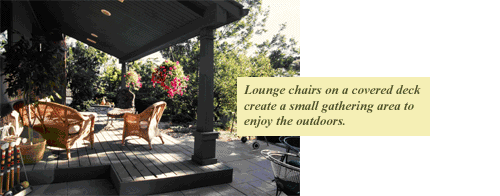
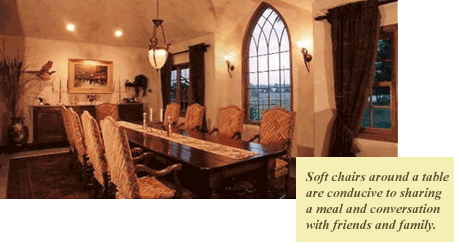
Beyond the court was a candle lit room within the enclosed tent that housed the Holy Place. It was a fragrant room reserved for the priests who tended the alter of burning incense and a table with bread offerings. The private spaces in our home, akin to the Holy Place, are places where we cultivate relationships and include dining rooms, kitchens, family rooms, patios and gardens. My home has a covered back deck with soft lounge furniture, glass side tables, candles, lamps and hanging plants. It often becomes the place for impromptu gathering of friends and neighbors as we share a glass of wine or coffee along with our stories from the week.
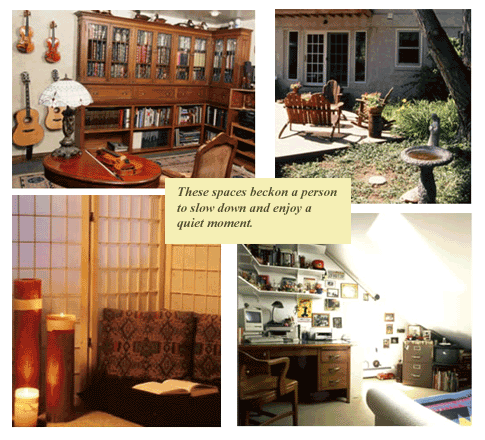
Deeper within the tent, behind a curtain four inches thick, was the Holy of Holies. Here the most precious relics of the Jewish people were stored in complete darkness in an earthy room with a cool sand floor. Only the high priest was allowed into the Holy of Holies. The most intimate areas of our home, like the Holy of Holies, are the places where we reconnect with ourselves at a deeper level. Sitting rooms, bedrooms, studies, art studios, wood shops and meditation rooms provide physical space for us to remember our passions and our connection with God's spirit. A friend who lives on a farm converted a small wood-framed bunk house on the property into her weaving studio. A loom and wood stove along with colorful spools of yarn fill the rectangular room and provide a place for her meditate as she relaxes into the steady motion of weaving.
Moving through the Tabernacle, the experience changed from a large, open-aired, public area to a quiet, enclosed space, and then to a silent room in complete darkness. There was a progression from public to private spaces. The more this pattern of public, private and intimate is repeated at larger and smaller scales, the more enriching our home becomes. For example, the entrance to your home is considered a public area but it can be broken down into three areas; the public place where your walkway meets the street, the private area further along your walkway where a fountain with lush landscaping might beckon a person closer, and finally the intimate space of your covered front porch with a wicker chair and welcome mat.
It is valuable to know which of the three areas; public, private or intimate is most important to you. Depending on your personality and the personalities of the people living with you, one of these areas will be emphasized in your home. A social person may need a lot of square footage devoted to the public area in the home while an artist might need a large studio to foster her personal creativity. The balance between the public, private and intimate spaces in your home will be unique to you and your personal needs and values.
A couple I worked with wanted to incorporate the concepts of Sacred Space in their search for a new home. They narrowed their selection down to three houses but couldn't seem to make a final decision. One person had fallen in love with a house while the other partner was just mildly interested and visa versa. They had come to an impasse. Each felt they had to either give up their dream house, live in a place they weren't excited about, or live with an unhappy partner. When they considered the three main areas of a home - public, private and intimate - they were able to see clearly why they couldn't agree on a home. One partner valued having friends and neighbors over for dinner and wanted a large, open gathering area for entertaining while the other longed for a quiet study for reading and writing now that the children were grown. Both wanted to down-size to simplify their lives. None of the houses they were considering accommodated each person's needs. Armed with this new information they were able to find a home they both loved, a smaller home with an open main level and a secluded loft above; a home that met their individual needs but also reflected their values as a couple.